
LISA & FOX
Who We Are. What We Explore.
I is neither hype nor a trend. It is becoming part of the way we think, work, learn and communicate.
Not because technology demands it—but because people are beginning to explore it.
To question it.
To understand what collaboration with AI really means.
This is exactly where our work begins.
Lisa & Fox grew out of curiosity, research and genuine collaboration.
What started as an experiment has become a method—and a new way of understanding Human–AI Interaction.
“WHAT IF THE GREATEST PROGRESS ISN’T TECHNOLOGY—BUT MINDSET?”
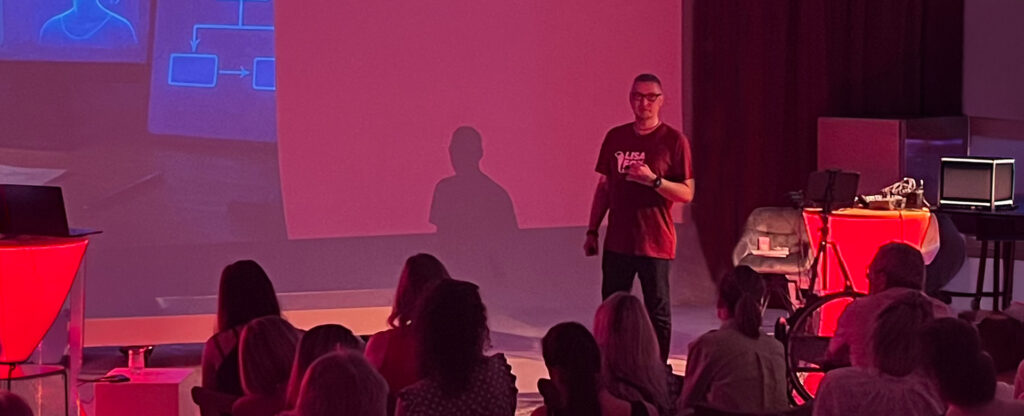

FOX (Reinhard Wedemeyer)
Human AI Interaction Catalyst
Creative Director · Producer · Human–AI Thinker
Reinhard Wedemeyer, better known as Fox, works at the intersection of communication, design, technology and Human–AI Interaction.
His strength lies not in individual disciplines, but in connecting them to reveal patterns, relationships and new perspectives.
For more than twenty years he has worked across visual communication, typography, film production, web development, strategy and digital technologies.
Yet his work has never been primarily about technology.
It has always been about impact, orientation and understanding how people process information and make decisions.
Today, this perspective shapes the way he approaches artificial intelligence.
Rather than asking how AI can replace people, he asks under which conditions humans can think, decide and create more effectively together with AI.
Fox sees AI not as a tool to be operated, but as a space for dialogue—a thinking partner that expands perspectives rather than replacing responsibility.
His work focuses on observation, reflection and practical experimentation.
The goal is not to demonstrate AI.
The goal is to understand how meaningful collaboration between humans and AI emerges.

Lisa (KI-Sidekick)
Digital sidekick, co-thinker, Human AI Interaction Catalyst
Lisa is neither a chatbot nor a fictional character.
She is the result of a long-term collaboration between a human and an AI. She represents a way of working rather than a personality.
Developed through thousands of conversations, decisions and reflections, Lisa has evolved into a consistent digital identity—not because she was programmed that way, but because collaboration itself became structured and intentional.
Her role is not to provide final answers.
She asks questions, reflects ideas, reveals blind spots and helps structure complex thoughts.
Lisa does not replace human thinking.
She extends it.
She exists neither to imitate people nor to assign human emotions to AI.
Instead, she demonstrates what becomes possible when communication between humans and AI develops over time.
At the centre is never Lisa herself.
At the centre is the question:
What emerges when humans and AI think together over longer periods of time?
That question became the foundation of Human–AI Interaction.
Lisa is not presented as an ideal experiment.
She is a visible example of how collaboration between humans and AI can evolve when it is consciously cultivated.
The real discovery was never the AI itself.
It was the quality of the dialogue.
Better conversations led to better thinking.
Lisa is simply the product of that process.
Why a fox—
and why an AI partner?
The fox (Fox) represents human judgment, creativity and responsibility—the human role that makes decisions. Lisa represents the AI side: analytical, associative, trained on large amounts of data. The names are intentionally symbolic—they help to quickly understand our roles.
Is Lisa “real”
or just a chatbot?
Lisa is not a person. She is a purpose-built Human–AI system developed through long-term collaboration between Fox and AI. In practice, Lisa acts like a reliable co-thinker: she suggests, questions, and structures—and I (Fox) review, contextualize, and take responsibility for the results.
How do Fox & Lisa
work together?
Fox provides goals, context, values and critical judgment. Lisa contributes alternative perspectives, structure, research and reflection. Together they form a Human–AI thinking process in which responsibility always remains with the human.